Multi-Agent Review Pattern
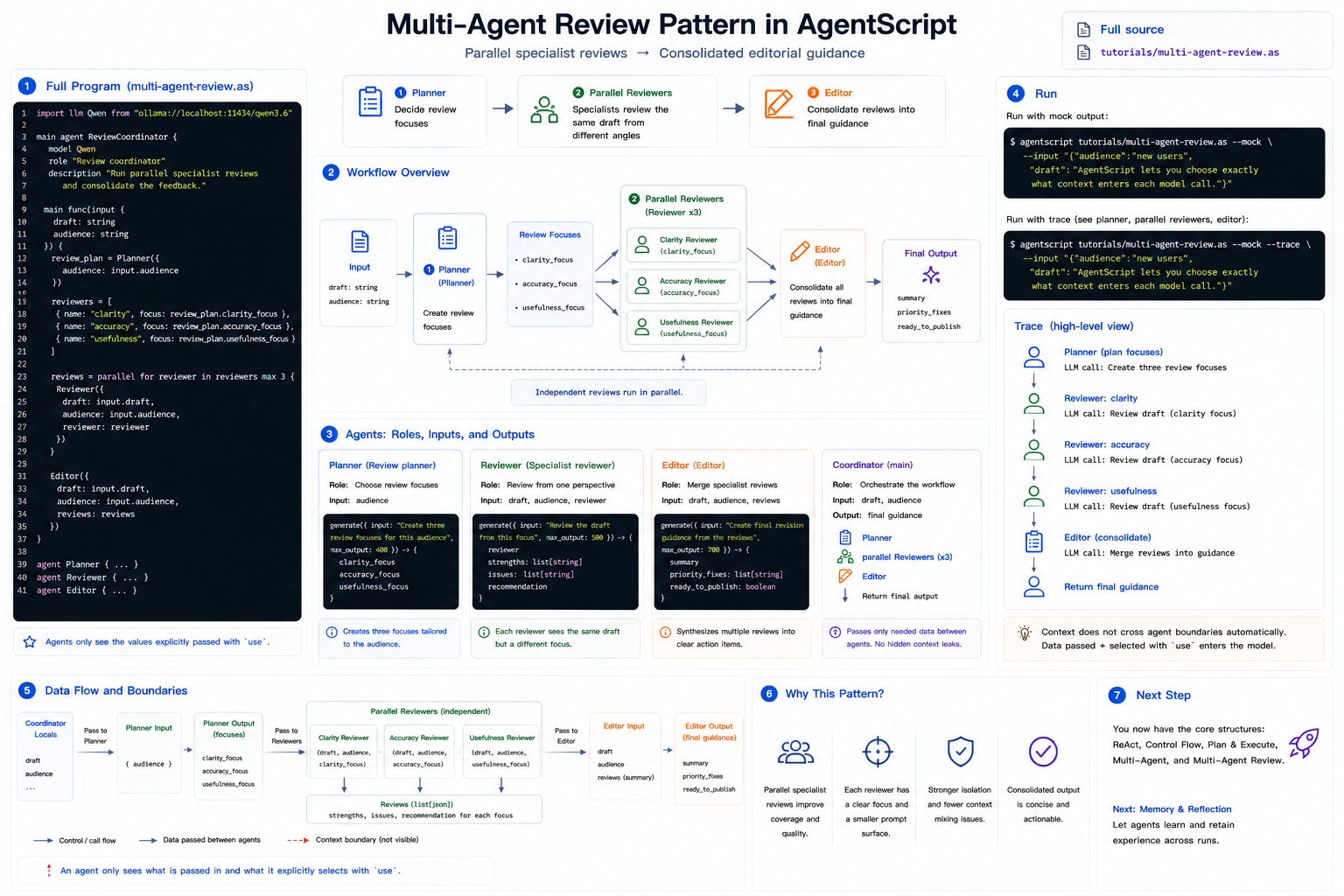
The previous tutorial introduced agent boundaries. This tutorial turns those boundaries into an application pattern: parallel specialist review.
The workflow is:
Plannerchooses review focuses.Revieweragents review the same draft from different perspectives.Editorconsolidates the reviews into final guidance.
Full source: ../../../tutorials/multi-agent-review.as
1. The Complete Program
Create multi-agent-review.as, or open the repository copy at
tutorials/multi-agent-review.as:
import llm Qwen from "ollama://localhost:11434/qwen3.6"

main agent ReviewCoordinator {
    model Qwen
    role "Review coordinator"
    description "Run parallel specialist reviews and consolidate the feedback."

    main func(input {
        draft: string
        audience: string
    }) {
        review_plan = Planner({
            audience: input.audience
        })

        reviewers = [
            {
                name: "clarity",
                focus: review_plan.clarity_focus
            },
            {
                name: "accuracy",
                focus: review_plan.accuracy_focus
            },
            {
                name: "usefulness",
                focus: review_plan.usefulness_focus
            }
        ]

        reviews = parallel for reviewer in reviewers max 3 {
            Reviewer({
                draft: input.draft,
                audience: input.audience,
                reviewer: reviewer
            })
        }

        Editor({
            draft: input.draft,
            audience: input.audience,
            reviews: reviews
        })
    }
}

agent Planner {
    model Qwen
    role "Review planner"
    description "Choose review focuses for a target audience."

    main func(input {
        audience: string
    }) {
        use input.audience as "audience"

        generate({ input: "Create three review focuses for this audience", max_output: 400 }) -> {
            clarity_focus
            accuracy_focus
            usefulness_focus
        }
    }
}

agent Reviewer {
    model Qwen
    role "Specialist reviewer"
    description "Review a draft from one focused perspective."

    main func(input {
        draft: string
        audience: string
        reviewer: json
    }) {
        use input.audience as "audience"
        use input.reviewer as "review focus"
        use input.draft max 2k as "draft"

        generate({ input: "Review the draft from this focus", max_output: 500 }) -> {
            reviewer
            strengths: list[string]
            issues: list[string]
            recommendation
        }
    }
}

agent Editor {
    model Qwen
    role "Editor"
    description "Merge specialist reviews into final editorial guidance."

    main func(input {
        draft: string
        audience: string
        reviews: list[json]
    }) {
        use input.audience as "audience"
        use input.draft max 2k as "draft"
        use input.reviews.summary max 3k as "specialist reviews"

        generate({ input: "Create final revision guidance from the reviews", max_output: 700 }) -> {
            summary
            priority_fixes: list[string]
            ready_to_publish: boolean
        }
    }
}
2. Plan Review Focuses
Planner turns the audience into three review focuses. This keeps the later
reviewers aligned without making them share one large prompt.
3. Run Specialist Reviewers in Parallel
Each reviewer receives the same draft and audience, but a different focus:
reviews = parallel for reviewer in reviewers max 3 {
    Reviewer({
        draft: input.draft,
        audience: input.audience,
        reviewer: reviewer
    })
}
This is a good use of parallel for: the clarity reviewer does not depend on
the accuracy reviewer, and both can run independently.
4. Consolidate With an Editor
Editor does not need every intermediate variable from the coordinator. It
receives only the draft, audience, and review results. Then it chooses what to
show the final model call:
use input.reviews.summary max 3k as "specialist reviews"
The pattern is useful whenever you want diverse feedback but one final answer.
5. Run It
Run with mock output:
agentscript tutorials/multi-agent-review.as --mock --input '{"audience":"new users","draft":"AgentScript lets you choose exactly what context enters each model call."}'
Print the trace to see the planner, parallel reviewers, and editor:
agentscript tutorials/multi-agent-review.as --mock --trace --input '{"audience":"new users","draft":"AgentScript lets you choose exactly what context enters each model call."}'
Next
You now have the main structural tools: ReAct, control flow, Plan-and-Execute, and multi-agent review. The next step is memory and reflection, where an agent can persist lessons across runs.